
Become a Trauma-Informed Plant Medicine Facilitator:
A Journey of Healing, Growth, and Connection
Guide others with empathy, safety, and deep care, supporting their healing and
transformation through the wisdom of plant medicine.
A 100-hour professional training for facilitators who want to bring trauma-informed principles into every stage of the plant medicine journey.
25 April – 14 November 2027 | Live Online & Self-Paced
The TIPMF program teaches you how to minimise harm, prevent re-traumatisation, and embody trauma-informed plant medicine principles from preparation to facilitation through to post-ceremony integration.
Deepen your capacity to recognise trauma responses, support nervous system regulation, and create containers that honour choice, agency and pacing. Gain the skills to navigate complexity, uphold ethical boundaries, and hold space with greater compassion, attunement and professionalism—so every journey is rooted in safety and supported transformation.
An essential and comprehensive 100-hour professional training for all psychedelic facilitators who want to lead with greater clarity, confidence and integrity, TIPMF gives you the foundation you need, including trauma-informed frameworks, somatic tools, nervous system understanding, and access to our community of committed psychedelic practitioners.
You’ll learn how to hold safer, more grounded spaces and respond skilfully when trauma or activation arises—so you can support clients more safely, with trauma-attuned approaches and ethical care at every stage of their experience.
This program consists of the following:
92 hours of live Zoom workshops with Atira and guest teachers, bonus masterclasses and demonstration sessions, a 600+ page manual, somatic tools, worksheets, community support, and a Certificate of Completion—all in one transformative program that you can learn at your own pace.
“THIS JOURNEY HAS BEEN LIFE-CHANGING.”
– Riva Jean-Paul, Artist and Trauma-Informed Somatic Coach & Facilitator
OUR PROGRAM AT A GLANCE
TRAINING OVERVIEW:
This 100-hour online certificate training is delivered across three comprehensive modules, giving facilitators the skills to understand and embody trauma-informed principles throughout the full arc of psychedelic and plant medicine work—from preparation, through the ceremony or medicine session, and into integration.
WHAT YOU’LL RECEIVE:
- 30 bite-sized video lectures
Build a strong foundation in trauma, somatic psychology, and trauma-informed psychedelic practice through accessible, focused lessons designed to deepen your understanding step by step. - 16 live, experiential training workshops
Go beyond theory. Develop practical skills, explore real-world scenarios, and learn frameworks for navigating complexity, challenging experiences, and complex trauma across every phase of the psychedelic arc. - Specialist masterclasses with experienced guest teachers
Deepen your understanding of the distinct considerations involved in working with ayahuasca, psilocybin, and MDMA, with perspectives that enrich your knowledge and inform your practice. - Live Q&A sessions, study groups, and mentorship
Bring your questions, explore the nuances of trauma-informed practice, and deepen your learning through guided discussion, shared reflection, and opportunities to connect theory with real-world situations. - Dedicated cohort connection and community-building
Learn alongside a cohort of practitioners who share your commitment to more responsible, trauma-informed psychedelic work. Dedicated time for connection, peer exchange, and shared reflection creates space to build meaningful professional relationships, learn from diverse experiences, and develop a network of support that extends beyond the training itself. - Opening and Closing Ceremonies
Begin your learning journey with intention and come together at its conclusion to reflect on your development, acknowledge your learning, and consider how you will carry these skills into your work.
- A comprehensive training manual and practical resources
Access a structured collection of learning materials, somatic practices, case studies, frameworks, and practical tools to support your understanding and application of trauma-informed principles. - Lifetime access to all session recordings
Revisit the teaching, consolidate your learning, and catch up on any live sessions you miss. Your access continues long after the program concludes, giving you a resource to return to as your practice evolves. - Bonus demonstration sessions
See the Somatic Plant Medicine Integration Model brought to life through practical demonstrations, illustrating how its principles can be applied in clinical and ceremonial contexts. - A dedicated self-study workbook
Consolidate your learning, deepen your understanding, and translate key concepts into meaningful reflection and practical application. - Access to our private Mighty Networks community
Connect with fellow practitioners, exchange perspectives, share learning, and build relationships with a community committed to more trauma-informed psychedelic practice. - Personal and professional reflection worksheets
Explore your own responses, examine your developing practice, and engage with the material through guided reflection, integration tools, and somatic self-care resources. - A comprehensive library of somatic practices
Build a practical toolkit of embodied approaches to support your work with clients, strengthen your own self-awareness, and cultivate greater capacity to remain present when working with complexity. - A Certificate of Completion
Receive your certificate upon fulfilling the programme’s completion requirements, recognising your commitment to developing your trauma-informed knowledge and skills.
FACILITATE WITH CONFIDENCE:
Trauma-informed practice is not about having the perfect response to every situation. It is about developing the awareness, knowledge, and practical skills to meet people with greater care, recognise your limitations, and respond thoughtfully to what is unfolding.
If you are committed to working responsibly with people in plant medicine and psychedelic settings, TIPMF offers a structured opportunity to deepen those skills and bring a more trauma-informed approach to your practice.
Join the 2027 Trauma-Informed Plant Medicine Facilitator Training.
OUR CURRICULUM
The TIPMF curriculum unfolds across three interconnected modules, taking you from the foundations of trauma-informed facilitation to the complexities of preparation, ceremony, and post-ceremony care.
TIPMF combines live online learning with self-paced study and practical application, allowing you to engage with the material in depth and integrate it into your professional practice.
Your training includes:
- Live experiential training: Interactive teaching and experiential exercises designed to help you translate theory into practice.
- Specialist masterclasses: Focused sessions exploring trauma-informed considerations in relation to psilocybin, ayahuasca, and MDMA.
- Q&A sessions: Opportunities to deepen your understanding and explore questions arising from the training.
- Study groups and mentorship: Dedicated spaces for reflection, discussion, and further learning.
- Self-paced video lectures: Educational material to support your learning between live sessions.
- Training manual and workbook: Resources to guide your study, reflection, and application.
- Practical resources and templates: Materials to support the development of your trauma-informed practice.
- Private online community: A space to connect with fellow participants throughout the program.
- Lifetime access to recordings: All live sessions are recorded, so you can revisit the material or catch up if you cannot attend a session.
The live training sessions are four hours long, with a 15-minute break halfway through. Self-study and between-session practice form part of the wider 100-hour program.
MODULE 1:
FOUNDATIONS OF TRAUMA-INFORMED PLANT MEDICINE FACILITATION
25 April – 8 July 2027
Develop a stronger understanding of trauma, the nervous system, and the ways people respond to intensity, vulnerability, and perceived threat in altered states. Build the foundational knowledge and practical skills to navigate complexity, challenging experiences, and trauma responses in psychedelic spaces.
MODULE 1 CURRICULUM:
- Overview of Trauma and the Nervous System
- Working with the Polyvagal Theory in Non-Ordinary States
- The different categories of trauma that show up frequently in altered states of consciousness
- The Shamanic Paradigm vs Western Contemporary Paradigms of Trauma Recovery
- Understanding Soul Loss and Dissociation
- Tips and Tools for mitigating the risk of re-traumatisation
- Identifying nervous system patterns and presentations in clients
- The Body is Key: support the intelligence of the body for healing in non-ordinary states
- The importance of Self-Regulation and Co-regulation
- Essential somatic skills for safety, grounding and resourcing
- Trauma-informed communication and relational skills
- Using Somatic Touch as a resource
- Consent, healthy boundaries and ethical responsibility
- Your role as facilitator in each phase of the trauma-informed plant medicine paradigm
- Working with Psilocybin and important tips for facilitators
HOW YOU’LL LEARN:
- 18 bite-sized video lectures covering essential concepts in trauma-informed and somatic practice.
- 8 live, four-hour Zoom workshops combining experiential learning, practical application, and trauma-informed facilitation frameworks.
- Specialist Psilocybin Masterclass with guest teachers exploring trauma-informed considerations when working with psilocybin.
- Live Q&A sessions to deepen your understanding and explore questions arising from the training.
- Video Lecture Study Guide to consolidate key concepts and support your independent learning.
- Downloadable PDF presentation slides for convenient reference and revision.
- Comprehensive 350-page training manual covering core theory, practical frameworks, and relevant applications.
- Personal and professional reflection worksheets to deepen self-awareness and examine your developing facilitation practice.
- Somatic practice resources to strengthen embodied awareness and support practical skill development.
- Curated reading list and journal article access to extend your learning and engage with relevant research.
- Bonus demonstration sessions to observe key concepts and approaches in practice.
MODULE 2:
TRAUMA-INFORMED PREPARATION, SCREENING & INTENTION SETTING
8 August – 16 September 2027
Develop a more considered approach to preparation, assessment, and intention-setting, with greater awareness of the complexities that may arise before a psychedelic experience. Learn to approach preparation with greater care, recognising that responsible facilitation begins well before a ceremony.
MODULE 2 CURRICULUM:
- Design and implement effective written applications for ceremonial and psychedelic sessions.
- Review applications through a trauma-informed lens, discerning relevant history, context, and potential support needs.
- Assess participant suitability and readiness to determine when further screening or an interview is appropriate.
- Conduct trauma-informed screening interviews to explore intentions, personal history, and individual circumstances.
- Recognise and track nervous system states, identifying signs that may inform readiness and the need for additional support.
- Assess environmental, relational, and emotional factors that may influence participant safety and readiness.
- Ask skilful, clarifying questions to inform screening decisions and identify potential concerns.
- Make informed suitability decisions about participation, recognising when additional support or referral may be needed.
- Prepare participants holistically across physical, emotional, psychological, psycho-spiritual, and environmental dimensions.
- Establish informed consent and clear boundaries, supporting participant agency and understanding of the process.
- Provide trauma-informed psychoeducation about the process, expectations, potential challenges, and possible trauma responses.
- Teach somatic resourcing skills to support participants before entering altered states, including somatic inquiry, somatic resourcing, and supportive touch.
- Guide psychological and emotional preparation using the Somatic Intention Setting Model.
HOW YOU’LL LEARN:
- 6 bite-sized video lectures exploring key principles of trauma-informed assessment, screening, and somatic intention setting.
- 4 live, four-hour Zoom workshops to explore the material through experiential learning, discussion, and practical application.
- Specialist Ayahuasca Masterclass with guest teachers examining trauma-informed considerations in ayahuasca contexts.
- Live Q&A session to explore questions and deepen your understanding.
- Video Lecture Study Guide to reinforce learning and support independent study.
- Downloadable PDF presentation slides for ongoing reference.
- Comprehensive 250-page training manual to support your understanding of the module’s core concepts and frameworks.
- Personal and professional reflection worksheets to examine your approach to preparation, assessment, and practitioner responsibility.
- Somatic practice resources to support embodied awareness and the application of somatic principles.
- Curated reading list and journal article access to deepen your understanding of the relevant theory and research.
- Bonus guides, intake templates, and handouts to support the practical application of key concepts in your work
MODULE 3:
POST-CEREMONY CARE AND EMBODIED INTEGRATION
26 September – 14 November 2027
Deepen your understanding of the integration process and develop skills to support participants navigating complex emotional, psychological, and somatic experiences after a psychedelic journey. Strengthen your understanding of the period following a plant medicine experience, when participants may be making sense of intense emotions, new insights, or unexpected difficulties.
MODULE 3 CURRICULUM:
- Apply the Hero’s Journey to trauma-informed integration, recognising its relevance while honouring each participant’s unique experience.
- Provide trauma-informed post-ceremony care, supporting participants through the complexities that may emerge in the hours, days, and weeks following a ceremony.
- Explore the dimensions of Self in plant medicine integration, including the physical, emotional, psychological, energetic, psycho-spiritual, and relational dimensions of experience.
- Recognise and work with trauma imprints that may emerge after a psychedelic experience, responding with sensitivity and appropriate care.
- Develop somatic skills in post-ceremony therapeutic care, responding to participants’ needs while maintaining appropriate professional boundaries.
- Use psychedelic integration documentation templates to support structured, individualised, and ongoing integration care.
- Design and facilitate integration workshops that foster reflection, connection, meaning-making, and practical application.
- Facilitate integration circles and group processes that encourage shared reflection while respecting individual boundaries and experiences.
- Use art, metaphor, and symbolism in integration to support creative exploration and meaning-making without imposing interpretations.
- Recognise three categories of psychedelic integration to better understand participants’ needs and tailor your approach accordingly.
HOW YOU’LL LEARN:
- 6 bite-sized video lectures exploring trauma-informed post-ceremony support and integration care.
- 4 live, four-hour Zoom workshops combining experiential learning, discussion, and practical approaches to integration.
- Specialist MDMA Masterclass with guest teachers exploring trauma-informed considerations relevant to this distinct psychedelic context.
- Live Q&A session to deepen your understanding and explore questions arising from the module.
- Video lecture study guide to consolidate learning and support continued reflection.
- Downloadable PDF presentation slides for convenient reference and revision.
- Comprehensive 200-page training manual covering relevant theory, frameworks, and practical applications.
- Personal and professional reflection worksheets to explore integration, practitioner self-awareness, and professional boundaries.
- Somatic practice resources to support embodied integration and build practical skills.
- Curated reading list and journal article access to extend your learning through relevant research and literature.
- Bonus demonstration sessions to observe key approaches and deepen your understanding of how to apply them.
AS A TRAUMA-INFORMED PLANT MEDICINE FACILITATOR,
YOU’LL BE ABLE TO…
- Reduce the risk of retraumatisation in participants
- Recognise trauma imprints and identify signs of trauma in participants during the preparation, ceremonial and integration phases of plant medicine work
- Create safe spaces and establish environments and facilitator-participant relationships that foster safety, trust and attunement
- Understand trauma awareness based on neuroscience and somatic psychology
- Possess knowledge of foundational principles of trauma and the nervous system to inform your facilitation approach
- Skilfully navigate psycho-spiritual challenges in non-ordinary states, addressing them with sensitivity and expertise
- Provide trauma-sensitive post-ceremony and integration support for trauma resolution
- Communicate in a trauma-informed manner that is compassionate and empathetic, ensuring safety in the interpersonal relationship
- Support trauma survivors in building their inner resilience and “Window of Presence” through somatic resourcing
- Uphold your ethical responsibility by prioritising the well-being and health of participants, both physically and psychologically
- Respond resourcefully to various trauma imprints and nervous system patterns, employing somatic resourcing strategies that lead to repair and prevent re-traumatisation
- Provide participants with psychoeducation on trauma awareness and support them in preparing for their ceremonial experience with mindfulness, somatic resources and support
OUR PROGRAM SCHEDULE
Live online learning, with the flexibility to learn at your own pace. All sessions take place online, with times listed in Central European local time (CEST/CET). Breaks between modules provide dedicated time for independent study, practical application, and completion of certificate requirements.
Every session is recorded, with lifetime access to recordings, so you can revisit the teaching and consolidate your learning long after the program concludes. A self-paced option is also available for those who prefer to work through the material on their own schedule.
MODULE 1:
| 25 April | Opening Ceremony | 5:00–7:30 pm |
| 6 May | Study Group | 5:00–7:30 pm |
| 15 May | Live Training | 5:00–9:00 pm |
| 16 May | Live Training | 5:00–9:00 pm |
| 22 May | Live Training | 5:00–9:00 pm |
| 23 May | Live Training | 5:00–9:00 pm |
| 5 June | Live Training | 5:00–9:00 pm |
| 6 June | Live Training | 5:00–9:00 pm |
| 12 June | Live Training | 5:00–9:00 pm |
| 13 June | Live Training | 5:00–9:00 pm |
| 24 June | Q&A Session | 5:00–7:30 pm |
| 1 July | Psilocybin Masterclass | 5:00–7:30 pm |
| 8 July | Mentorship Session | 5:00–7:30 pm |
MODULE 2:
| 8 Aug | Ayahuasca Masterclass | 5:00–7:30 pm |
| 19 Aug | Study Group | 5:00–7:30 pm |
| 28 Aug | Live Training | 5:00–9:00 pm |
| 29 Aug | Live Training | 5:00–9:00 pm |
| 4 Sep | Live Training | 5:00–9:00 pm |
| 5 Sept | Live Training | 5:00–9:00 pm |
| 16 Sept | Q&A Session | 5:00–7:30 pm |
MODULE 3:
| 26 Sept | MDMA Masterclass | 5:00–7:30 pm |
| 7 Oct | Study Group | 5:00–7:30 pm |
| 16 Oct | Live Training | 5:00–9:00 pm |
| 17 Oct | Live Training | 5:00–9:00 pm |
| 23 Oct | Live Training | 5:00–9:00 pm |
| 24 Oct | Live Training | 5:00–9:00 pm |
| 4 Nov | Q&A Session | 5:00–7:30 pm |
| 14 Nov | Closing Ceremony | 5:00–7:30 pm |
WHO IS THIS TRAINING FOR?
TIPMF is designed for practitioners who want to deepen their trauma-informed understanding and strengthen the quality of care they offer in plant medicine and psychedelic settings.
- Plant medicine facilitators and ceremonial practitioners.
- Psychedelic guides and practitioners.
- Therapists, counsellors, and coaches working in related settings.
- Integration practitioners and other professionals supporting people before or after psychedelic experiences.
- Experienced practitioners seeking to develop their understanding of trauma, somatic awareness, and nervous system responses.
This training complements your existing professional background. It does not replace foundational facilitator training, clinical qualifications, or professional licensing where these are required.
YOUR TEACHER

With over two decades of experience in international development, Atira has been a trailblazer on the frontlines of humanitarian work, from refugee camps to disaster zones, and among survivors of war, torture, and trafficking. Her advocacy for women’s rights and reproductive health has been groundbreaking, particularly in her work with sex-trafficked survivors across Asia and the Pacific. As the founder of Art to Healing, Atira has spearheaded initiatives that have empowered thousands of survivors and their communities, fostering freedom from trauma, slavery, and oppression.
Passionate about shining light on life’s most challenging spaces, Atira worked as the Director of Preparation and Integration at AYA Healing Retreats for 7 years. She is the visionary behind the pioneering Trauma-Informed Plant Medicine Facilitator Training and the Somatic Plant Medicine Integration Program, which have collectively trained over 1,000 graduates, setting a new standard for safety and ethics in the field.
Atira’s expertise has shaped psychedelic-assisted therapy and facilitator training programs globally. She collaborates with leading organizations, including ICEERS, Plant Spirit School, Inward Bound, Tam Integration, BMed, Kiyumi, Mind Medicine Australia, and Synthesis, where she serves as a faculty member. She also co-directs the Somatic Psychedelic Facilitator Certificate at The Embody Lab.
Born in Singapore and raised in Melbourne, Atira now resides between Spain and Thailand, as she advances her Ph.D. research at EGS. Her work continues to inspire a new generation of psychedelic-assisted therapists and ceremonial guides dedicated to trauma-informed care and the integration of plant medicine into modern therapeutic practices.
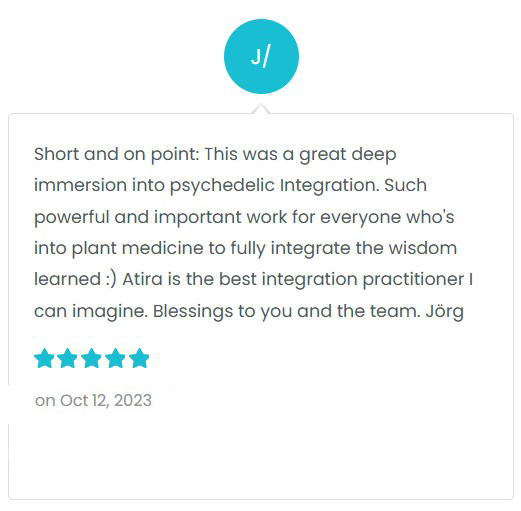
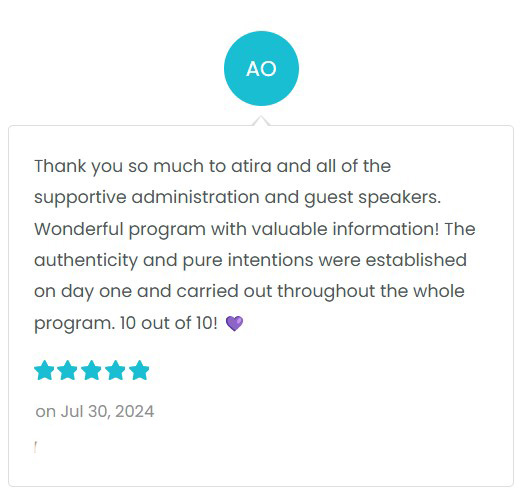
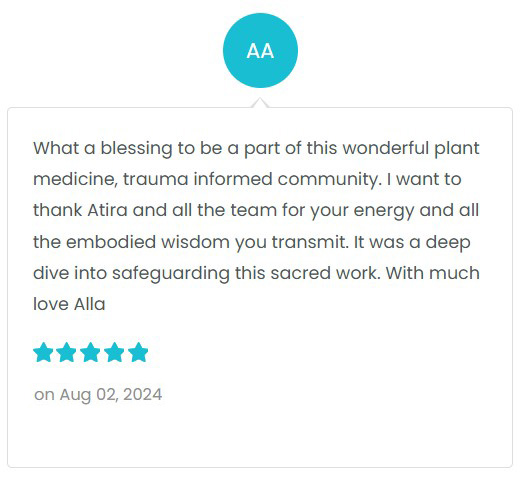
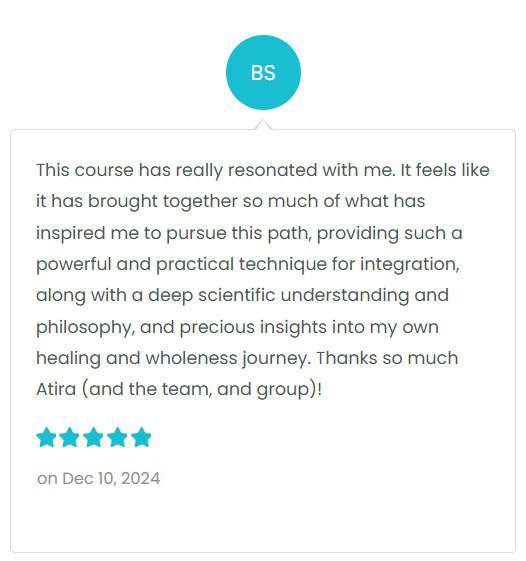
WHAT STUDENTS SAY

“What a life-changing experience. This training is a true treasure of knowledge and wisdom and shared with a caring and loving presence.
The depth of insights into a variety of tools to create safer spaces is the most I have ever experienced in any training. However, besides the theoretical teachings, what touched me the most was how the space was held in such safety and care and naturally became the soil for our personal softening into the journey.
And with that, we were able to truly experience the effect of a teacher who fully embodies what she teaches. And that is a priceless gift I will benefit from for the rest of my life.”

“Atira’s extensive knowledge on the subject of trauma and working within the PM context has been immensely beneficial.
I’ve gained a deeper sense of how to hold the container of healing, which in turn, opens doors for journeyers to be met with more compassion, understanding, and safety to move through their process.”

“After completing the Trauma-Informed Plant Medicine Facilitator training, I organised an Ayahuasca retreat for close friends (with an experienced curandero) and implemented the trauma-informed principles throughout the entire journey.
Just WOW – the trauma-informed tools, resources and techniques was so well-received and created such a nourishing, supportive environment for the group to dive deeper into their own healing. Witnessing their breakthroughs and transformations was pure magic for me.
Thank you for equipping me with the education, tools, and the trauma-informed lens to be able to hold a safe container. It truly makes such a difference in everyone’s plant medicine experience, and I’m very grateful for all of the wisdom that Atira has shared with us!”
“Participating in this training gave me profound insight into my role as a ceremony guide and integration & microdosing coach. It illuminated areas where I can grow, and strengthened & expanded my toolbox of resources, practices, processes, protocols and tools to be able to support people in their healing journeys beyond my expectations.
Atira carries a strong and very clear vision of the importance of a trauma-informed approach and awareness to work in this rapidly growing field of plant medicine & psychedelic assisted therapies.
Being in her presence and receiving her teachings was extremely inspiring and motivating for me to continue showing up for this very much-needed work.
I highly recommend the Trauma Informed Plant Medicine Facilitation Training for anyone involved in facilitating, curating or providing psychedelic & plant medicine assisted therapies and healing who is interested in providing a space for embodied change and long-lasting positive results.”

“As different cultures around the world continue to share and integrate their wisdom for us to heal physically, socially, mentally, energetically and spiritually through psychedelics and plant medicine, I believe it is essential that we understand how to navigate the trauma imprints that each culture carries and how each modality or treatment can affect them differently.
Through the Trauma-Informed Plant Medicine Facilitator program, I was able to get a deeper and more detailed education and perspective in how to create safer spaces (before, during and after ceremony), in order to facilitate “real” trauma healing, and to truly care for a patient’s needs.
In my experience, this is something tremendously important and very few facilitators have yet managed to incorporate this approach of trauma-sensitivity into their practices. I’m very grateful to Atira and her team for sharing this knowledge and for creating a safe and beautiful container with wonderful humans who are on similar paths to mine.
I recommend this training 100%!”
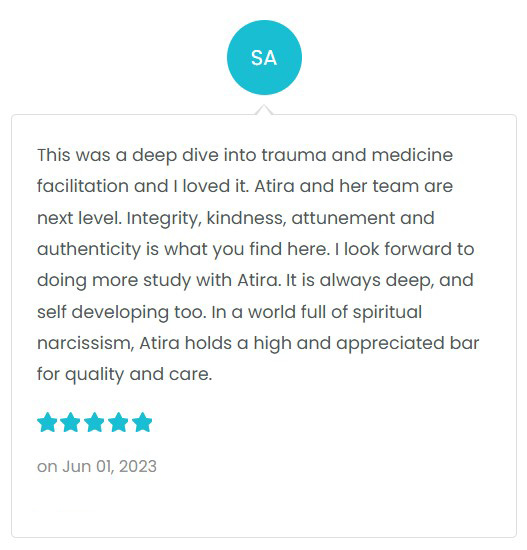
“Wow!! I just want to say thank you for holding space for such an incredible informational experience.
I feel that I have SO many resources now to draw upon now. Atira is filled with experience and hold such beautiful, vibrant energy that is powerful. I feel safe, and seen in her presence!
True magic!”
“I cannot recommend this training enough for anyone working in the plant medicine space; whether you are pouring medicine, a supporter/facilitator, a pre or post-ceremonial integration specialist, or even a student of the plants. I strongly feel that this training should be the basic foundational training (alongside 1st Aid) for all healers and support plant medicine staff.
Atira is an excellent bridge and guide into the intersectional realms of plant medicine and trauma therapy.”

YOUR INVESTMENT
* This program can be completed by joining our Zoom workshops live or as a self-paced learning experience by watching the recordings. You’ll receive lifetime access to the program for as long as our company and learning spaces are running. In the unlikely event that we can no longer operate, access may end at that time. We encourage you to complete the training within 2 years.
* All students receive a certificate of completion upon the submission of certificate requirements.
This program is for educational purposes only. Before practising, always seek the advice of your physician, psychiatrist, psychologist or other qualified healthcare providers, with any questions you may have regarding a medical or psychological condition or treatment and before undertaking a regimen.
By using and/or purchasing any of our Programs, Products, Site, Subscriptions, Services and Program Materials, you understand and agree that all sales are final and no refunds will be provided. Please read our Terms and Conditions before booking. Your payment is confirmation that you have read and agree to our terms and conditions.